 Astrool
Vedic Birth Chart (Kundli)
Your Jyotish kundli in the sidereal zodiac: Lagna, Moon sign, birth nakshatra, the planetary periods you are living through, and the yogas and doshas that tradition reads in your chart.
What a Vedic birth chart is
A kundli (also janam kundli or janma patrika) is the birth chart of Indian astrology, Jyotish. It records where the Sun, Moon, five visible planets and the lunar nodes Rahu and Ketu stood at the exact minute and place you were born. Unlike Western astrology, it is calculated in the sidereal zodiac, which is anchored to the fixed stars.
Because the sidereal zodiac currently sits about 24 degrees behind the tropical one (the ayanamsa), most people find their Vedic Sun sign is one sign earlier than the sign they know. That is not a contradiction: the two systems measure the same sky from different starting points.
What you'll discover in the report
- Your Lagna (rising sign), Rashi (Moon sign) and Surya (Sun sign) in the sidereal zodiac
- Your birth nakshatra and pada, the lunar mansion that colours your inner nature
- Your Vimshottari dasha timeline: which planetary period you are in now, its sub-periods, and what comes next
- The yogas that actually form in your chart, such as Gaja Kesari, Raja and Dhana yoga
- Your Manglik, Kaal Sarp and Sade Sati status, with dates
- Your Navamsa (D9) chart and traditional remedies (upaya)
North Indian and South Indian chart styles
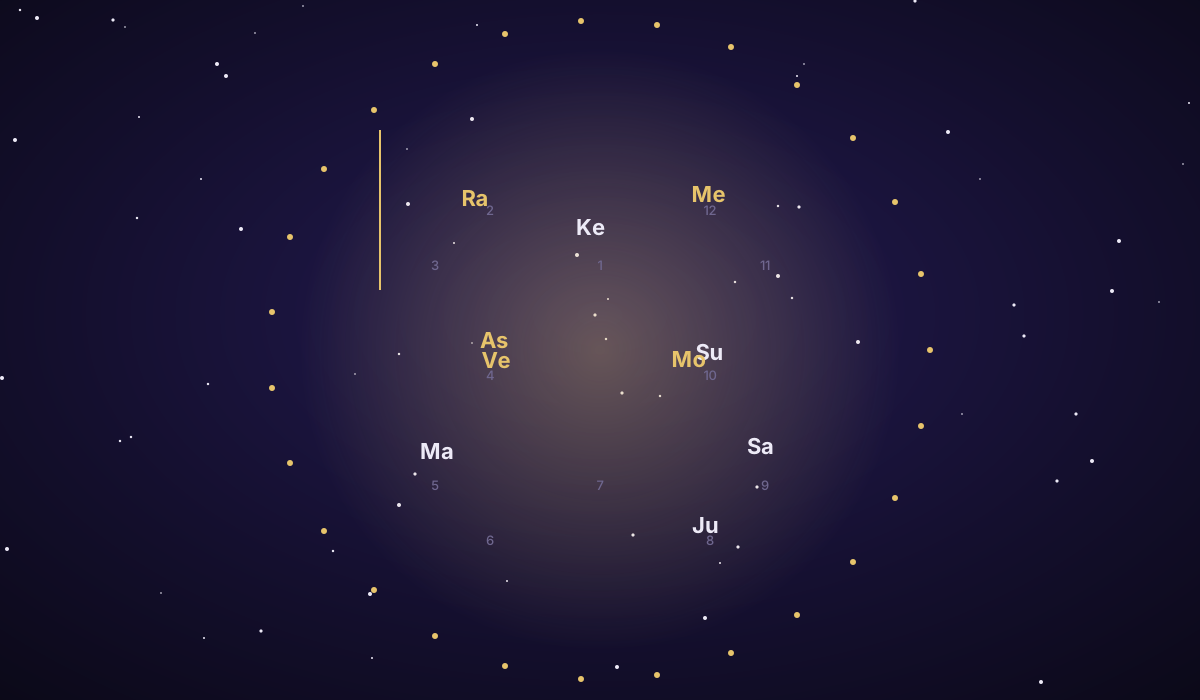
Astrool draws the kundli in both traditional layouts. The North Indian chart is a square divided into diamonds: the houses stay fixed and the sign numbers move, with the Lagna always at the top centre. The South Indian chart fixes the signs in a grid of twelve boxes and marks the Lagna wherever it falls. Both show the same chart; switch to whichever your family or astrologer uses.
How the calculation works
- Your birth date, exact time and city are converted to Universal Time and geographic coordinates.
- Planetary positions are computed from a real astronomical ephemeris, then shifted by the Lahiri ayanamsa into the sidereal zodiac.
- Houses are counted whole-sign from your Lagna, the classical Jyotish method.
- The Moon's exact degree fixes your nakshatra and pada, and how far through it the Moon had travelled sets where your dasha sequence starts.
- Yogas and doshas are tested against the classical rules, and only the ones that really form are listed.
Doshas are not curses
A dosha is a placement tradition treats as needing care, not a verdict. Manglik dosha, for example, simply means Mars occupies the 1st, 4th, 7th, 8th or 12th house; in matchmaking it is weighed against the partner's chart, and two Manglik charts are considered to balance each other. Astrool explains each dosha in plain language rather than using it to frighten you.
Vedic vs Western birth chart
| Vedic (Jyotish) | Western | |
|---|---|---|
| Zodiac | Sidereal (star-based) | Tropical (season-based) |
| Key sign | Moon sign and Lagna | Sun sign and Ascendant |
| Houses | Whole-sign from Lagna | Usually Placidus |
| Timing | Dasha periods | Transits and progressions |
| Outer planets | Not used traditionally | Uranus, Neptune, Pluto |
| Lunar mansions | 27 nakshatras | Not used |
Neither is more correct. They answer slightly different questions, and many people find reading both side by side the most useful. Your Western chart is in the birth chart section of Astrool.
Open this report in Astrool
Astrool calculates your full birth chart, not just your sun sign, and writes your daily, weekly and monthly readings against it.
Common questions
Why is my Vedic Sun sign different from my Western one?
Vedic astrology uses the sidereal zodiac, which today sits about 24 degrees behind the tropical zodiac used in the West. If your Sun is in the first 24 degrees of a Western sign, it falls in the previous sign in your Vedic chart.
Do I need my exact birth time?
Yes. The Lagna changes about every two hours and the dasha periods depend on the Moon's exact degree. Without a time the report still shows your Moon sign and nakshatra in most cases, but houses, Lagna and yogas need the time.
Which ayanamsa does Astrool use?
Lahiri (Chitrapaksha) by default, the standard of the Indian government calendar. Raman, Krishnamurti and Fagan-Bradley are available in the app settings.
Is being Manglik bad?
No. It describes a fiery, direct Mars in relationships. In traditional matching it is weighed against the partner's chart, and many authorities consider it cancelled by other factors.
Can I make a kundli for someone else?
Yes. You can generate the report for any person whose birth details you have, for example to compare with a partner in Birth Chart Compare.